LUCA, the seed of life. May be it is not the first living thing in the earth but is considered as the common ancestor of all current life on Earth. Though we have not any fossil or remains from it, we can trace it from DNA's of current living things. A 2016 study shows that 355 genes are common at all current living things and probably with LUCA too.
Biological classification, three-domain system, presents life under three domains, Eukaryote, Archaea and Bacteria. Eukaryotes have nucleus and the other organelles while the other domains don't. When we trace the origin of life through these domains we see that eukaryotes are evolutionary updated cells that follow bacteria and Archaea 1 billion year later. However, bacteria and Archaea have similar attributes which are considered as common in LUCA too. Both of them have genetic codes which is the set of rules by which information encoded within genetic material (DNA or mRNA sequences) is translated into proteins by living cells means cells use energy. And the things begin to be interesting at that point, while both of these three-domain cells have machinery to generate this energy LUCA don't. (This was theorized by Peter Mitchell in 1961. This theory succeed him to Nobel Prize in 1978 and remembered as the most counter-intuitive idea in biology since Darwin.)
Cells produce energy to pump protons to out of the cell. (Respiration – Photosynthesis). This leads the difference in concentration of ions between in and out of the cell. Next movement of protons in order to achieve equilibrium across the membrane generates ATP, which is required for living things.
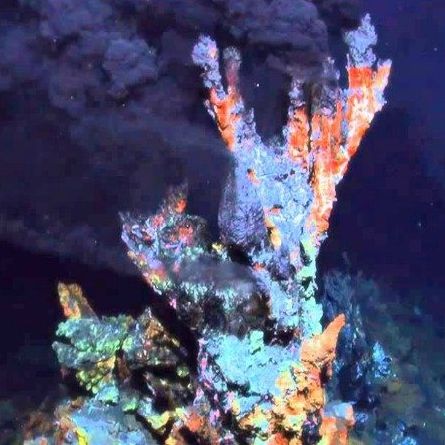
However, LUCA do not have any system like that. It is dependent to its environment. The theory argues that LUCA was present at hydrothermal vents. This obtain proton rich environment and trigger the proton movement and ATP generation too.
In December 2000, The Lost City Hydrothermal Field is found. Speculation has been offered that ancient versions of similar hydrothermal vents in the seas of a young Earth are the birthplace of all life, constituting the original abiogenesis. The free hydrogen, metallic catalysts consistent with an iron-sulfur world theory, micro-cellular physical structure of the towers and available hydrothermal energy might plausibly have provided an environment for the beginnings of non-photosynthetic energy cycles common to Archaea and organic molecule creation.
The earth, 4 billion years ago, lack of oxygen and relatively heavy atmosphere, under the sun light and radiation is not suitable for life however hydrothermal vents under the cover of deep oceans ideal to reproduction and evolution.
Charles Darwin proposed the theory of universal common descent through an evolutionary process in his book On the Origin of Species in 1859, saying, "Therefore I should infer from analogy that probably all the organic beings which have ever lived on this earth have descended from someone primordial form, into which life was first breathed”.